DeFi mindshare is on the floor. The tourists are gone, the timelines moved on, and everyone keeps asking the same question without really wanting the answer: is DeFi actually dead?
So I stopped guessing and went to find out.
I picked one protocol to dig into. Not a random one. @pendle_fi, which to me is one of the most fundamental protocols in DeFi, the one nearly every advanced user ends up holding as part of a diversified strategy. If there is a living user base anywhere in deep DeFi, it should be here.
My starting data point was DeBank, claiming Pendle has more than 200,000 users. So I pulled every Pendle user's on-chain history since 2022, all 40.6M transfer events across 11 chains, and counted how many are still exposed to a live market today.
14,646.
That is not a typo. Nobody is lying to you. That number just counts something else.
What the 200,000 actually counts
That headline is a sum of per-chain depositor counts. A wallet active on 3 chains gets counted 3 times, and on Pendle that overlap is huge: 66,571 wallets used both Ethereum and Arbitrum alone.
* BSC is a flagged lower bound (dropped logs in dense windows).
Dedupe properly and 672,980 distinct wallets have touched Pendle. Bigger than the headline, not smaller.
But "touched" is doing enormous work in that sentence.
Of those 672,980 wallets, 291,052 ever held real principal, an actual fixed-yield or LP position. 96,898 still hold one today, most of them in expired markets. And that 14,646 from the top? It is anyone still exposed to a live market, holding PT, YT, LP, or SY in a market that has not expired.
Was it all bots, and were the numbers inflated all along?
My first instinct was that the cheap chains were bot farms. Base produced 100 times more on-chain events per reported depositor than Ethereum. That smelled like sybils.
I built a classifier on 9 on-chain signals, funding clusters, same-block coordination, cloned action sequences, 24/7 activity, and resolved the wallet type for 99% of all 672,980 addresses.
The verdict: about 5% are bots. Berachain was the worst at 10.9%, driven by liquidity incentives.
Strip every bot out and the all-time count drops 5%. The market underneath does not move.
So is DeFi dead?
Here is the honest curve.
Monthly active Pendle wallets peaked at 176,772 in April 2024, the top of the points-farming mania. By June 2026 it was 14,138. Down 92%.
The honest read is churn, not death.
The median wallet in that entire dataset made 2 transactions and never came back. 464,808 wallets, 69% of everyone, have been silent for over a year.
If you define DeFi by the tourist wave, then yes, it looks dead. The crowd that showed up to farm an airdrop is gone.
The cohort math says the same thing. 25% of new users come back the month after, and 6% are still active 6 months on. Of everyone who ever took a real position, only 10% still hold a live one a year later.
Yet.
Look at the money, not the headcount. Pendle still has $1.007B locked, up 6% on the month, and it throws off around $24M a year in real fees. A protocol does not hold $1B of other people's money and print $24M of revenue by being dead.
Source: DefiLlama, Pendle protocol page, July 2026.
Look at the money
The wallets still there transact like they mean it. And the metric I care about most, whether someone rolls into a new position when their old one matures, is quietly recovering. The blended rollover rate is a weak 32%, but that average is dragged down by the giant 2024 farming cohort that rolled at 22%. Recent quarters tell a different story, climbing but choppy: 49% in Q3 2025, 50% in Q4, a dip to 25% in Q1 2026 when 3x as many positions came due at once, then 58% in Q2 2026.
DeFi is not dead. It is post-tourism. A small, committed core doing real size, surrounded by a graveyard of wallets that came for the incentive and left.
And Pendle is the proof, not the exception: it kept $1B and its most serious users while the crowd walked out. That is what a protocol growing up looks like.
A few words on Otomato
I run Otomato, and this whole study is a 673,000-wallet argument for why it exists.
The single healthiest signal I found is rollover: people re-entering when a position matures. And the single biggest failure I found is people forgetting they hold a position at all. 466,450 wallets still have money sitting in Pendle, most of it in markets that expired long ago, matured PTs nobody redeemed and SY nobody unwrapped. Both are the same problem. Nobody is watching the position for you, so the moment it needs action, the moment it matures, depegs, or a better market opens, you are not there.
That is the entire job Otomato does. It reads your wallet, knows your Pendle positions, and pings you when one is about to expire, with the live markets you can roll into. That is the whole product.
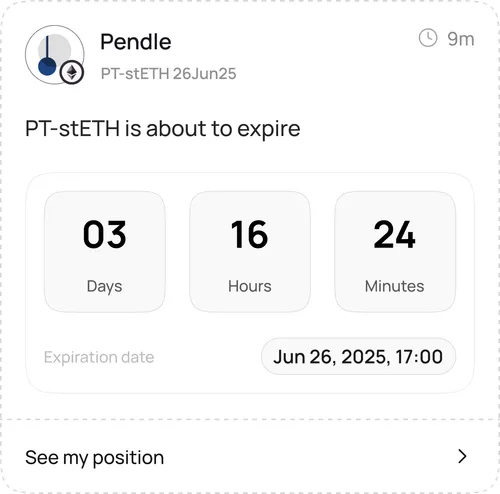
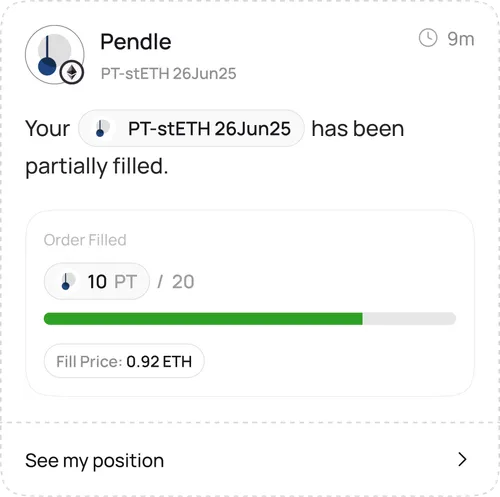
On a strict 30-day clock, 68% of maturing Pendle positions never get rolled, blended across every cohort, and even the recent engaged cohorts still miss 45% or more. Most of that is not conviction, it is just nobody reminding them.
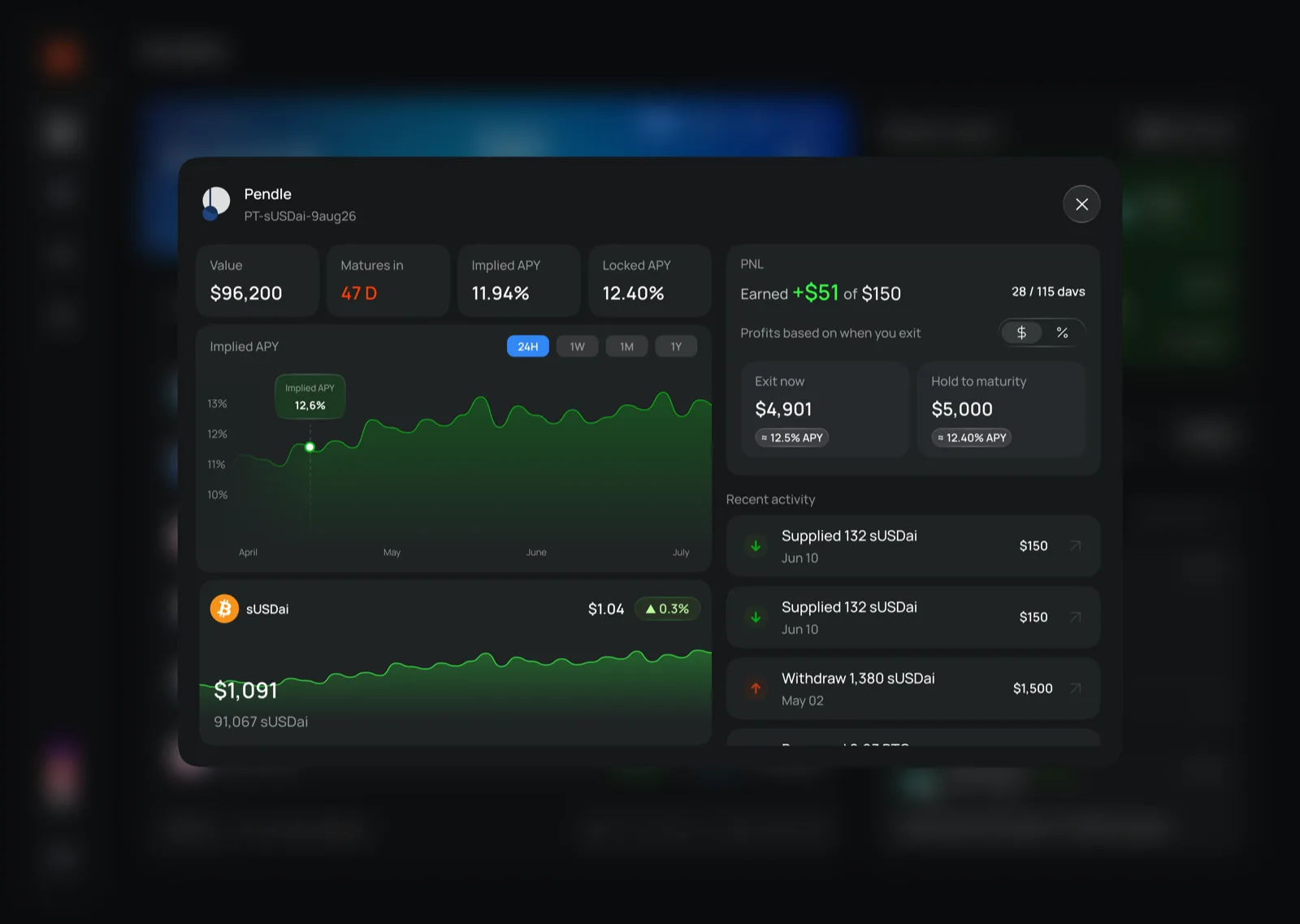
Watch your Pendle positions before one quietly expires
Paste an address and Otomato detects every position across 12 chains, then pings you the moment a PT matures or a market needs action. Low-noise, portfolio-aware, no setup.
This was one protocol. I want to do the same teardown on the next one, same depth, same on-chain honesty. Which protocol do you want me to analyze next?

Clément Hecquet
Co-founder and CEO of Otomato. Engineer turned product leader, building the portfolio-aware alerts layer for on-chain users.
Related articles
Pendle PT Maturity: What Happens When Your Position Expires
Your Pendle PT position has a maturity date. Here is what happens when it expires and why you should track it.
Zero-Setup DeFi Monitoring: No Signatures, No Configuration
Monitor your DeFi positions without connecting your wallet. Just provide your address and Otomato detects everything automatically.