HYPE is doing something almost nothing else in crypto is: it printed a fresh all-time high near $77 in June, while the rest of the market sits far below its own peaks. In January it bottomed near $21. Held from the first day's close, it did 10.7x.
Almost nobody held. The median recipient sold at $6.25.
The token is a success. But can we say the same about the airdrop?
A rising price proves people want to buy HYPE. It does not prove the giveaway did its job: turning free tokens handed to 94,019 strangers into users who stick around. So I analyzed every wallet that received it.
No sampling. I took the full genesis list, removed the 4 tokenomics buckets that were never users, and followed every one of the remaining 94,019 wallets across the Hyperliquid API, the Lighter API, HyperEVM, and every on-chain form of holding HYPE. Every number below is a full-population count. HYPE is priced at $67 here.
Did they keep the token? No.
Start with the most literal definition of a successful airdrop: the people who got tokens still hold them. By that measure it was a rout. 86% of recipient wallets have sold every single token they received. Add the partial sellers and 93.2% of all the HYPE that was dropped has left the wallets it landed in.
Of the 271M HYPE distributed, 252.4M has been sold or moved off the receiving wallet. What is left is thin: 10.7M still staked, 4.8M in spot, and roughly 1M each as HyperEVM native balance, liquid staking tokens, and lending collateral. Total still held today: 6.8%.
But splitting wallets into just sold or held hides the shape of what happened. Here is what every recipient actually did, from the ones that dumped all of it to the ones that ended up with many times what they were given:
Size bought a little conviction, and not much. 79% of the 1,000+ HYPE allocations sold out completely, against 89.6% of the smallest wallets. Even at the top, 4 in 5 sold every token they had. There is a believer tail though: 1,586 wallets now hold more HYPE than they were given, 239 of them more than 10x, sitting on 9.8M HYPE above their original drops, about $657M at today's price.
Did they at least sell well? No.
86% sold everything, so the next question is what they got for it. I reconstructed the exit price of every wallet that sold. The median seller got $6.25 per HYPE, against $67 today. Weighted by the amount sold, the median exit is $11.40. 69.1% of sellers got out below $10, 82.4% below $20, and of the 84,682 sellers, 191 got out above today's price.
Of the 208.5M HYPE I can trace out of those wallets, recipients realized $2.81B. The same tokens are worth $14.00B today.
Did they keep trading?
Selling the token, even at $6.25, is not the same as leaving the platform, and an airdrop is really trying to buy users.
Count wallets and it is ordinary airdrop decay: 72.1% are gone. Weight the same wallets by the HYPE they received and it inverts. The ones that left barely got anything, and the wallets holding 68.7% of the drop are still there.
Almost everyone showed up at least once: 99.7% of recipients have traded at some point. The best of the 252 who never did is a wallet that parked $500k in the HLP vault for 2.5 years, never placed a trade, and collected 104,000 HYPE for its patience.
How many actually stayed?
Here is the catch. The users who stayed are not a crowd. They are whales.
Among the 11,069 wallets active in the last 30 days, volume collapses onto a tiny group. They moved $45.5B in a single month, and 319 of them, 0.3% of the whole airdrop, did 92% of it. At $131M a month each, those 319 are market makers, not retail survivors. Strip them out and the other 10,750 active wallets still trade about $335k a month apiece. At the other end, 43% of active wallets trade under $10k a month and together move essentially nothing.
The pattern is clean once you line it up: whales sold their tokens hardest and stayed to trade anyway, while small recipients held their tokens and disappeared. 29% of the biggest recipients are still active today, against 6.4% of the smallest. Retention climbs with allocation, and that is no accident. The drop paid for volume and liquidity, so the largest checks went to people whose full-time job is trading on Hyperliquid.
Were they just farmers that switched to the next farm? No.
The loudest reason to call the airdrop a failure is the one on every timeline: that Hyperliquid's users are draining to Lighter, the nearest competitor and the obvious next farm. The data does not support it.
12.3% of recipients opened a Lighter account, the loosest possible definition of farming it. Under 1%, 812 wallets, ever actually traded there. And the curiosity is not churn: of the wallets that opened a Lighter account, 32% are still active on Hyperliquid this month. The people checking out the competition are among the most engaged Hyperliquid users, hedging their bets, not walking away.
The more interesting migration went the other way, deeper into the ecosystem. HyperEVM is the on-chain layer that turns a perps trader into a full DeFi user, and 26.3% of recipients have used it at least once. Weighted by allocation, those users received 74.2% of the airdropped HYPE, and among wallets still active in the last 30 days, HyperEVM usage climbs to 73.5%. The loyal core does not just trade perps. It lives on both layers.
So, was it a success?
The answer is genuinely both, and which one you believe depends on what you thought the airdrop was for. If it was meant to create long-term token holders, it failed plainly: 6.8% of the HYPE is still held and 86% of wallets sold everything. Yet if it was meant to buy loyalty for a trading venue, it is arguably the best customer-acquisition trade in crypto history.
On its first day HYPE opened at $2.00 and closed at $6.25, so the 271M tokens handed to users were worth somewhere between $0.5B and $1.7B when they landed. The same tokens are worth roughly $18B today. In exchange, 19 months later, Hyperliquid has about 11,000 monthly-active wallets doing $45.5B a month and a 26% HyperEVM adoption beachhead.
See your own Hyperliquid year
Curious where your wallet lands in these numbers? Hyperliquid Wrapped breaks down your volume, PnL, and activity in one page. Free, no wallet connection needed.
Open Hyperliquid WrappedA few words on Otomato
I can reconstruct what 94,019 wallets did over 19 months. Nobody was reconstructing mine while it was happening.
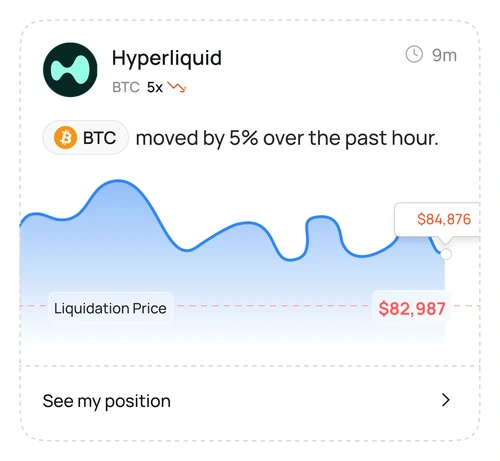
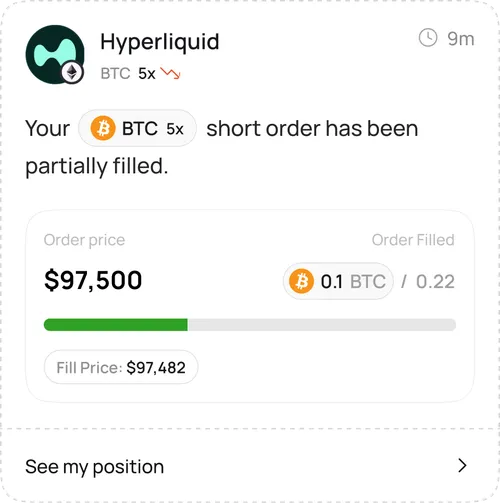
That is the job Otomato does: it detects every position across your wallets and alerts you only when something materially changes risk, cost, or requires action. If nothing changes, you hear nothing. If a position moves, you find out immediately.
Paste a wallet, it's free
Otomato detects every position you hold across 12 chains and tells you the moment one moves. Low-noise, portfolio-aware, no setup.
The best airdrop in crypto history bought users who did not want its token. Which airdrop do you want me to run this on next?

Clément Hecquet
Co-founder and CEO of Otomato. Engineer turned product leader, building the portfolio-aware alerts layer for on-chain users.
Related articles
Hyperliquid Perps Monitoring: Liquidation, Funding Rates, Order Fills
Monitor your Hyperliquid perpetual positions for liquidation risk, funding rate spikes, and limit order fills.
Multi-Chain DeFi Monitoring: Ethereum, Arbitrum, Base, HyperEVM
Managing positions across multiple chains is complex. Here is how to keep track without checking every dashboard.